Personalized Radio: Your AI Audio Guide for 2026

Personalized radio is defined as an AI-curated, continuously evolving audio stream that adapts to your taste, mood, and context without requiring manual playlist management. Unlike a static playlist or on-demand catalog, a true personalized radio station learns from your listening behavior and adjusts in real time. Platforms like musen and Subwave represent two distinct approaches to this technology, one cloud-hosted and one fully self-hosted, while open-protocol projects built on Bitcoin Lightning and Nostr are pushing the economics of audio streaming in an entirely new direction. The result is a hands-free, adaptive audio experience that works for you whether you are commuting, studying, or cooking dinner.
How does personalized radio use AI to power your stream?
Personalized radio works by replacing the skip button with an algorithm that already knows what you want to hear. Continuous adaptive streams learn from your behavior, including your preferred tempo, mood, and time of day, then queue the next track before you even think to search for one. That shift from active selection to passive reception is the core value proposition.

The most notable feature of modern AI radio is the agentic AI DJ. This is a layer of intelligence that sits above the music catalog and controls pacing, transitions, and interaction. Agentic AI DJs announce song intros, share weather updates, and call out the time, mimicking the rhythm of human broadcast radio without a single manual input from you. The DJ role and the music catalog are kept separate by design. That separation means the AI controls the flow of your station while your personal taste still shapes every track selection.
The contrast with traditional playlists is significant. A playlist is a fixed list you manage. A personalized audio station is a living broadcast that manages itself.
- No skip button required. Removing manual controls reduces decision fatigue by pushing linear pacing that mirrors classic broadcast radio.
- Mood and tempo adaptation. The stream adjusts based on signals like time of day, recent listening history, and user-set preferences.
- AI DJ interaction. The station announces context, not just music, giving you useful information without breaking your focus.
- Continuous playback. There are no awkward gaps or buffering pauses between tracks or content types.
Pro Tip: If you find yourself constantly skipping tracks on a playlist, switch to an AI radio station with no skip function for one week. Most listeners report that passive listening feels less exhausting than active queue management.
What are the privacy and technical options for self-hosted radio?
Self-hosted personalized radio gives you full control over your data. Subwave runs a local AI DJ on your own hardware, using a local large language model such as Llama 3.2 via Ollama, and connects to your personal music library through APIs like Subsonic or Navidrome. Your listening habits never leave your machine.
One architectural detail sets self-hosted radio apart from personalized playlists: the shared broadcast stream. All listeners on a Subwave station hear the same sequence at the same time, just like traditional radio. This avoids the algorithmic bubble problem where every listener gets a completely isolated, personalized shuffle that never overlaps with anyone else’s experience.
The tradeoff is technical complexity. Self-hosted radio systems require backend server management, music library API integration, and ongoing maintenance of the local LLM. You also need to curate your music library thoughtfully, because the AI DJ can only work with what you give it.
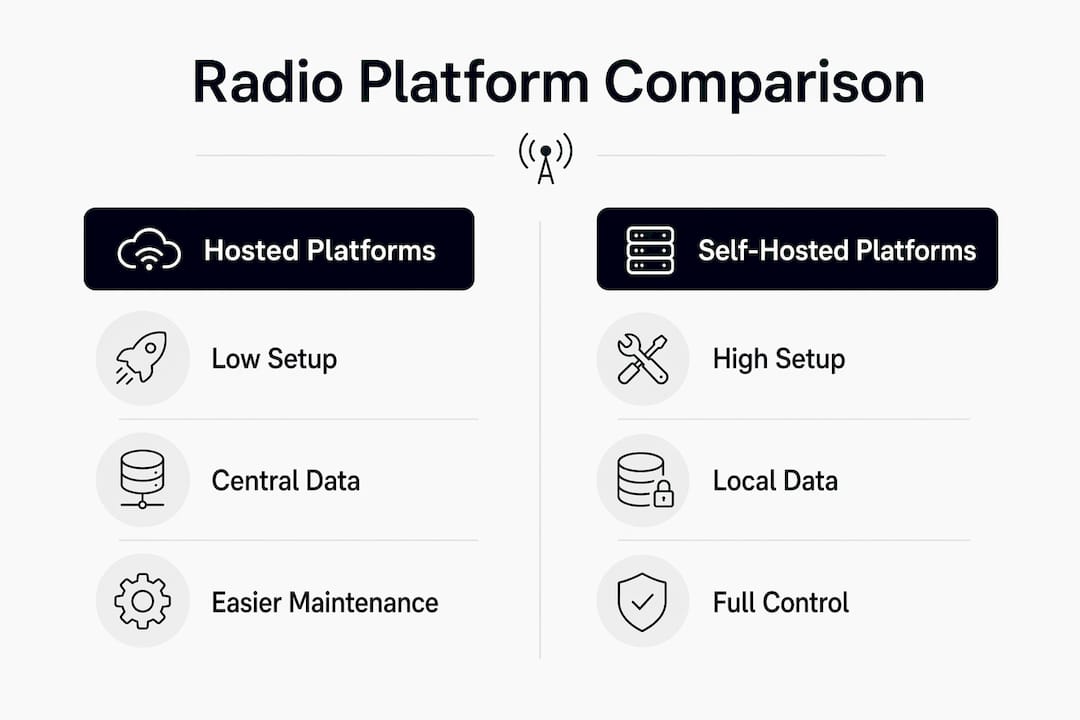
| Feature | Hosted platforms | Self-hosted platforms |
|---|---|---|
| Setup complexity | Low | High |
| Data privacy | Varies by provider | Full local control |
| Music library | Provider catalog | Your own collection |
| AI DJ capability | Cloud-based | Local LLM (e.g., Llama 3.2) |
| Cost | $0–$10/month | Hardware and time investment |
Pro Tip: Before setting up a self-hosted station, organize your music library with consistent metadata tags. The AI DJ relies on genre, tempo, and mood tags to make intelligent transitions. Poor tagging produces choppy, incoherent streams.
How do value-for-value payments change personalized radio?
The standard ad-supported streaming model pays artists fractions of a cent per stream, routed through multiple intermediaries. Value-for-value radio built on Bitcoin Lightning and Nostr protocols replaces that model with direct micropayments from listener to artist, measured in satoshis per minute of listening time.
This is not a theoretical concept. Open-source personal radio projects already implement real-time tipping where listeners pay artists directly as the track plays. Open-protocol radio creates what developers call a “sovereign audio” environment: no engagement-optimization algorithm deciding which artists get promoted, and no ad revenue pool diluting compensation.
The benefits for each party in this model are concrete:
- Artists receive direct, real-time compensation tied to actual listening time, not algorithmic play counts.
- Listeners get an ad-free experience and the ability to tip creators they genuinely value.
- Hosts operate without needing to sell advertising or negotiate licensing deals with intermediaries.
- The ecosystem rewards genuine discovery over viral promotion driven by platform incentives.
The Nostr protocol adds a social layer to this economy. Artists and listeners can interact directly, and station hosts can build communities around shared taste without a centralized platform controlling the relationship.
Practical ways to use personalized radio every day
Personalized radio fits naturally into the parts of your day when your hands and eyes are busy but your ears are free. Here are the most effective use cases for professionals, students, and content creators:
-
Morning commute news digest. Connect an RSS feed from your preferred news sources to an AI audio station. You arrive at work already briefed, without touching your phone. Whisprstream’s daily audio digest does exactly this, turning articles and threads into a continuous spoken stream.
-
Deep work background audio. Tempo-matched instrumental streams reduce distraction during focused work sessions. An AI DJ that reads your mood and adjusts the energy level of the music keeps you in flow without requiring you to manage a queue.
-
Study sessions with context-aware audio. Students benefit from stations that shift from high-energy tracks during reading to slower, ambient audio during note-taking. Adaptive tempo selection based on time-of-day signals handles this automatically.
-
Hands-free information consumption. Professionals who want to stay current on industry news without screen time can build personalized audio stations from RSS feeds, X threads, and newsletters. Whisprstream converts text content into podcast-style audio stations that play continuously in the background.
-
Evening wind-down listening. An AI radio station that detects evening hours and shifts toward lower-tempo, calmer content helps you decompress without actively curating a playlist.
The common thread across all these scenarios is the same: you set the station once, and it runs. The AI handles the rest.
Key Takeaways
Personalized radio delivers the most value when AI handles curation, pacing, and adaptation so you can focus on everything else.
| Point | Details |
|---|---|
| AI replaces manual curation | Continuous adaptive streams learn your taste and remove the need to manage playlists. |
| Agentic AI DJs add context | The DJ layer controls pacing and announcements while your music taste shapes every track. |
| Self-hosting protects privacy | Platforms like Subwave run local LLMs and keep your listening data entirely on your hardware. |
| Value-for-value payments are real | Bitcoin Lightning and Nostr protocols enable direct artist micropayments with no intermediaries. |
| Hands-free use cases are broad | Professionals, students, and creators all benefit from audio stations that run without active management. |
Why I think personalized radio is the most underrated shift in audio right now
I have spent years watching the audio industry chase on-demand everything. Every platform added more catalogs, more playlists, more recommendations. The result was more decisions, not fewer. Listeners ended up spending more time managing their queues than actually listening.
Personalized radio solves a problem that on-demand streaming created. The passive pleasure of traditional broadcast radio, where you just tune in and let it run, was genuinely valuable. AI-driven stations restore that experience while adding the customization that broadcast radio could never offer. That combination is more powerful than it sounds.
What excites me most is the privacy and payment layer. Self-hosted stations running local LLMs represent a real alternative to surveillance-based recommendation engines. And value-for-value micropayments via Bitcoin Lightning are not a niche experiment anymore. They are a working model that pays artists fairly and removes the platform as a gatekeeper.
The next three to five years will determine whether these open protocols scale. If they do, the economics of audio streaming change fundamentally. Artists get paid by listeners who actually value their work. Listeners get ad-free, algorithm-free audio. Platforms that depend on engagement optimization will face real competition from sovereign audio environments that no single company controls.
The technology is ready. The adoption curve is the only remaining question.
— Pedro
Whisprstream turns your content feeds into a personal audio station
If the idea of a hands-free audio station built from your own content sources appeals to you, Whisprstream is the most direct way to get there. You connect your RSS feeds, X accounts, or paste in articles, and Whisprstream converts them into continuous AI-narrated audio you can listen to anywhere.
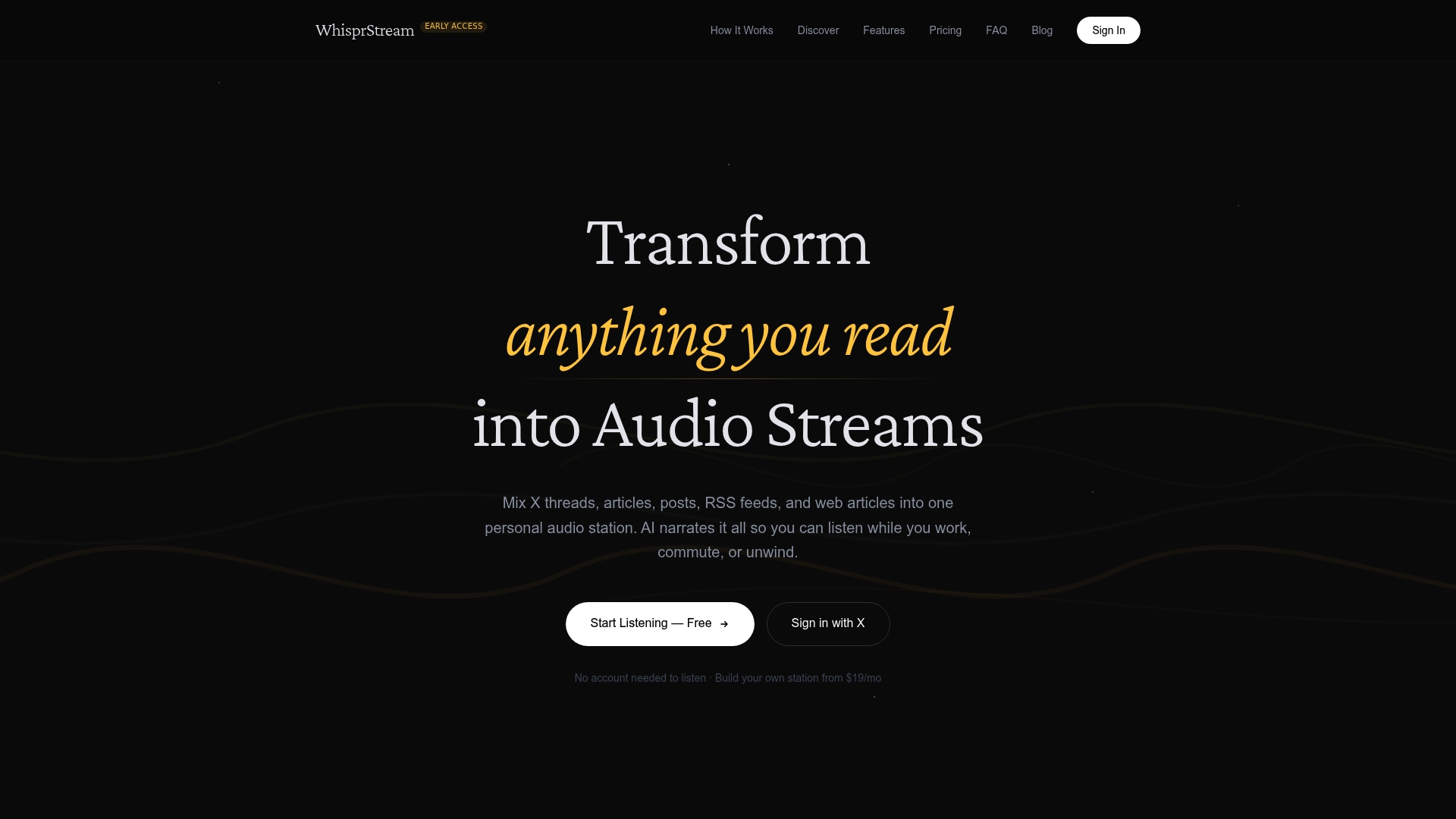
Whisprstream works especially well for professionals who want to absorb industry news during a commute, students who prefer listening over reading, and content creators who want to stay current without screen time. You can browse live AI audio stations built by other users, or build your own from scratch in minutes. The narration handles multiple content formats without awkward pauses, so your station sounds like a real broadcast, not a text-to-speech robot. Start at whisprstream.com and have your first station running today.
FAQ
What is personalized radio?
Personalized radio is an AI-curated audio stream that adapts continuously to your taste, mood, and context without requiring manual playlist management. It differs from on-demand streaming by operating like a broadcast station that learns from your behavior.
How does a personalized radio app differ from a playlist?
A playlist is a fixed sequence you build and manage yourself. A personalized radio app generates and adjusts your stream automatically, often using an AI DJ to control pacing, transitions, and context-aware announcements.
Can I run a personalized radio station without sharing my data?
Yes. Self-hosted platforms like Subwave run entirely on local hardware using local LLMs, keeping your listening data off external servers. The tradeoff is a higher technical setup requirement compared to cloud-hosted options.
What is value-for-value radio?
Value-for-value radio uses Bitcoin Lightning and Nostr protocols to send direct micropayments from listeners to artists in real time, measured in satoshis per minute. This model removes ads and intermediaries from the compensation chain entirely.
How do I build a personalized audio station for hands-free news?
Connect your preferred RSS feeds or social media accounts to an AI audio platform like Whisprstream. The platform converts text content into continuous spoken audio that plays without any manual input, giving you a hands-free news digest you can listen to during your commute or workout.