Audio 2.0: Your Guide to Next-Gen Listening

Audio 2.0 is defined as the integration of AI-powered software and intelligent processing layered onto audio playback to personalize and enhance sound beyond basic stereo configurations. This is not about adding a subwoofer to your desk setup. It is about software that reads your environment, adapts to your ears, and delivers audio tuned specifically for you. Technologies like L-Acoustics’ Source Intelligence, Apple’s H2 chip, and generative models such as UniAudio 2.0 are driving this shift. The result is clearer calls, more immersive music, and spoken content that feels made for you.
What is audio 2.0 and what powers it?
Audio 2.0 runs on three core layers: generative AI models, computational audio algorithms, and real-time signal processing. Each layer does a distinct job, and together they produce an experience that traditional stereo hardware simply cannot match.
Generative AI models are the foundation. The UniAudio 2.0 and Audex models were trained on 100 billion text tokens and 60 billion audio tokens, and 157.4 billion audio tokens respectively. That scale means these models understand context, not just sound waves. They can generate speech, music, and ambient audio that fits a specific mood, topic, or listener profile.

Computational audio algorithms run directly on your device. The AirPods Max 2 delivers up to 1.5x more active noise cancellation using Apple’s H2 chip. That improvement comes entirely from software processing, not from thicker ear cushions or bigger drivers.
Real-time signal processing handles the hardest problem: latency. On-device audio processing runs under 8.5 ms, which means the system reacts faster than your brain notices a delay. That speed makes adaptive audio feel natural rather than mechanical.
Key capabilities that define the Audio 2.0 stack:
- Voice isolation: Separates speech from background noise in real time, even in crowded spaces
- Adaptive EQ: Adjusts frequency balance based on your ear geometry and the ambient environment
- Generative narration: Creates spoken audio from text with natural pacing and intonation
- Semantic compression: The SALAD-VAE model achieves semantic audio compression at a 7.8 Hz latent rate, preserving meaning while reducing file size
- On-device privacy: Processing happens locally, so your audio data never leaves your device
Pro Tip: If you use wireless earbuds for calls, check whether your device supports on-device voice isolation. This single feature reduces background noise more than any physical upgrade you can make.
How does Audio 2.0 differ from traditional stereo formats?
The term “2.0” creates real confusion. In speaker configuration language, 2.0 means two channels: left and right. Audio 2.0 as an intelligent software concept is something entirely different. Modern Audio 2.0 systems treat stereo hardware as a base layer, then add AI-driven adaptive processing on top.
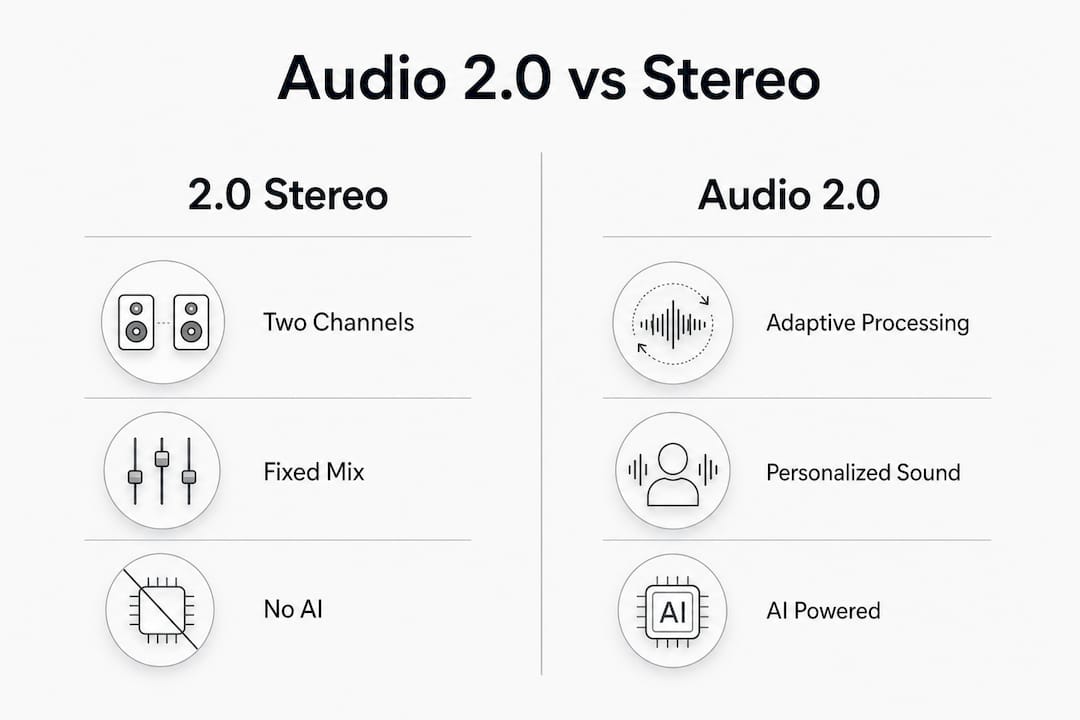
Traditional stereo plays back a fixed mix. The engineer who mastered the track made every decision about balance, reverb, and EQ before the file ever reached your ears. You get what they gave you, regardless of whether you are in a quiet library or a noisy subway car.
Next-gen audio formats change that relationship. Object-based audio formats like MPEG-H support channel-based, object-based, and immersive audio with user interactivity. That means you can independently adjust dialogue volume, choose a commentary language, or shift the spatial position of sounds during playback.
| Format | Channel count | Adaptive processing | User control | AI personalization |
|---|---|---|---|---|
| 2.0 stereo | 2 | None | None | None |
| 2.1 stereo + sub | 3 | None | Bass level only | None |
| 5.1 / 7.1 surround | 6–8 | Limited | Speaker balance | None |
| Dolby Atmos | Up to 128 objects | Rendering only | Minimal | None |
| Audio 2.0 (AI-driven) | Any | Full, real-time | High | Yes, per listener |
The table makes the gap clear. Channel count is a hardware spec. Personalization is a software capability. You can have a two-channel setup and still access full Audio 2.0 features if the processing layer is present.
What are the real benefits of Audio 2.0 for everyday listeners?
The practical gains from next-gen audio features show up in four areas of daily life: calls, music, media, and spoken content. Each one benefits from a different part of the Audio 2.0 stack.
-
Clearer calls in noisy environments. L-Acoustics’ Source Intelligence removes up to 40 dB of background noise with latency under 8.5 ms. That is the difference between being understood on a windy street corner and having to step inside to finish a conversation.
-
Personalized music playback. Adaptive Audio platforms adjust volume, noise cancellation, and EQ in real time based on your context. Walking from a quiet office into a loud café triggers an automatic recalibration. You do not touch a setting.
-
Longer, richer AI-generated audio. Stable Audio 3.0 generates variable-length audio up to 6 minutes and 20 seconds, compared to a 2-minute ceiling for earlier on-device models. That makes AI-generated background music and narration practical for real listening sessions.
-
Spoken content that adapts to you. Platforms like Whisprstream convert RSS feeds, social media threads, and articles into continuous AI-narrated audio. You assemble your own station and listen while you commute, cook, or work out. The narration flows without awkward pauses between content types.
-
Gaming and immersive media. Object-based audio lets game developers place sounds as independent objects in 3D space. You hear footsteps from the correct direction, not just the left or right channel.
Pro Tip: For spoken content specifically, look for platforms that handle multiple content formats in a single continuous stream. Switching between apps or manually queuing articles kills the listening habit before it starts.
What emerging audio formats and trends does Audio 2.0 enable?
The next wave of audio content delivery moves away from fixed files toward interactive, cloud-assisted, and personalized streams. MPEG-H is the clearest example of where this is heading.
MPEG-H supports multi-lingual commentary and selectable audio objects. A single broadcast file can carry multiple dialogue tracks, ambient sound layers, and commentary options. The listener chooses what they hear, not the broadcaster. This is a fundamental shift in how audio content is produced and delivered.
Cloud-based audio production workflows make this practical at scale. Producers no longer need to create separate mixes for every language or accessibility requirement. They publish one object-based file, and the playback device assembles the right version for each listener.
| Trend | Technology | Listener benefit |
|---|---|---|
| Interactive audio | MPEG-H object-based audio | Control dialogue, music, and commentary independently |
| Generative narration | UniAudio 2.0, Stable Audio 3.0 | AI-created spoken content at scale |
| Adaptive personalization | Snapdragon Sound, H2 chip | Real-time EQ and noise adjustment per listener |
| Semantic compression | SALAD-VAE | High-quality audio at lower bandwidth |
| AI audio stations | Whisprstream | Continuous personalized spoken streams from any text source |
The AI developments driving these trends are accelerating. Devices that felt premium in 2024 now represent the entry point. The gap between what a $300 pair of earbuds can do and what a professional mixing suite could do five years ago is closing fast.
Whisprstream fits directly into this picture. It applies Audio 2.0 principles to content delivery, turning your reading list into a personalized audio station. The open-source AI models powering narration quality continue to improve, which means the spoken experience gets better over time without you changing anything.
My honest take on where Audio 2.0 is actually headed
The part most listeners miss is the gap between hardware capability and software activation. You can own a device with every Audio 2.0 feature built in and never experience any of them because the app you use does not call those features. The H2 chip in AirPods Max 2 is extraordinary. But if you are listening through a browser tab playing a standard MP3, you are getting 2003-era audio.
The real upgrade is not buying new hardware. It is choosing content platforms and apps that actually use the processing power you already have. I have seen people spend hundreds of dollars on new headphones and then continue consuming audio through the same low-quality pipeline. The hardware is not the bottleneck.
Personalization is also more nuanced than the marketing suggests. Adaptive EQ based on ear geometry works well for music. For spoken content, the more important variable is content curation. Hearing a perfectly equalized article you do not care about is still a waste of your time. The platforms that combine AI narration quality with smart content assembly are the ones worth your attention.
The challenge ahead is standardization. MPEG-H is a strong format, but adoption across streaming platforms is uneven. Generative audio models are improving fast, but the best ones are not yet embedded in the apps most people use daily. The next two years will determine which Audio 2.0 features become default and which stay niche. My bet is on adaptive personalization and AI-generated spoken content. Both solve real problems that listeners feel every day.
— Pedro
Whisprstream brings Audio 2.0 to your content feed
Audio 2.0 is most useful when it works on the content you actually care about. Whisprstream applies AI-powered narration and personalized audio delivery to your existing reading list, turning threads, articles, and RSS feeds into a continuous spoken stream.
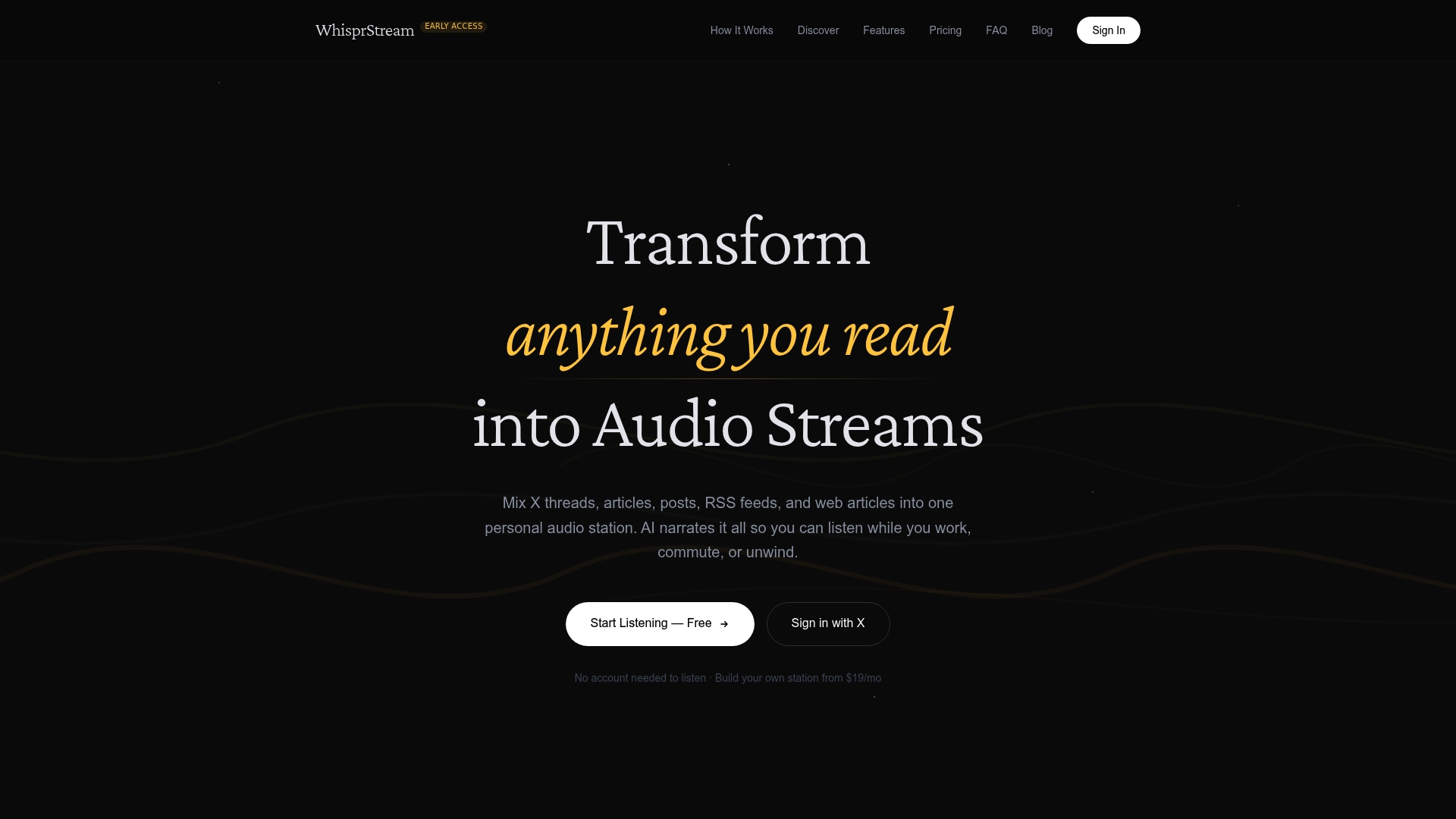
You connect your X accounts or paste any RSS feed, and Whisprstream assembles a station that plays without interruption. The AI narration handles multiple content formats without awkward transitions. Whether you are catching up on daily spoken summaries or building a personal knowledge station, the experience adapts to what you want to hear. Start your audio station and put your reading list to work while you move through your day.
FAQ
What is Audio 2.0?
Audio 2.0 is AI-powered audio processing that personalizes and enhances sound in real time, going beyond fixed stereo playback. It includes adaptive EQ, voice isolation, generative narration, and object-based audio formats.
How does Audio 2.0 differ from 2.0 stereo?
2.0 stereo refers to a two-channel speaker configuration with no adaptive processing. Audio 2.0 is a software intelligence layer that can run on any hardware, including standard stereo setups.
What devices support Audio 2.0 features?
Devices like AirPods Max 2, powered by Apple’s H2 chip, support adaptive audio and voice isolation natively. Qualcomm’s Snapdragon Sound platform brings similar features to Android devices.
What is object-based audio?
Object-based audio, as used in MPEG-H, treats individual sounds as independent objects rather than fixed channel mixes. Listeners can control dialogue and tracks independently during playback.
How can I improve my audio experience without new hardware?
Choose platforms that use AI narration, adaptive processing, and personalized content delivery. Whisprstream converts your reading list into a continuous AI-narrated audio stream, applying Audio 2.0 principles to everyday content consumption.
Key takeaways
Audio 2.0 delivers its full value only when intelligent software processing is paired with content platforms that actively use it, not just hardware upgrades.
| Point | Details |
|---|---|
| Software defines the experience | AI processing layers, not channel count, separate Audio 2.0 from traditional stereo. |
| On-device speed matters | Real-time audio processing under 8.5 ms makes adaptive features feel natural, not delayed. |
| Object-based formats give you control | MPEG-H lets you adjust dialogue, language, and sound layers independently during playback. |
| Content curation is half the equation | Personalized AI narration platforms like Whisprstream apply Audio 2.0 to your actual reading list. |
| Hardware is already ahead of software | Most listeners own capable devices but use apps that never activate their advanced audio features. |