Top 6 ai text to speech platform alternatives 2026
Sourcing an AI text to speech platform that streams audio from articles and social content with reliable voices is inconsistent across vendors. Many platforms restrict content types, gate key features behind enterprise pricing, or require complicated integrations for voice controls and streaming. This list sets out price, voice quality, and streaming options so producers and teams can match a platform to their workflow and content formats.
Table of Contents
WhisprStream
At a Glance
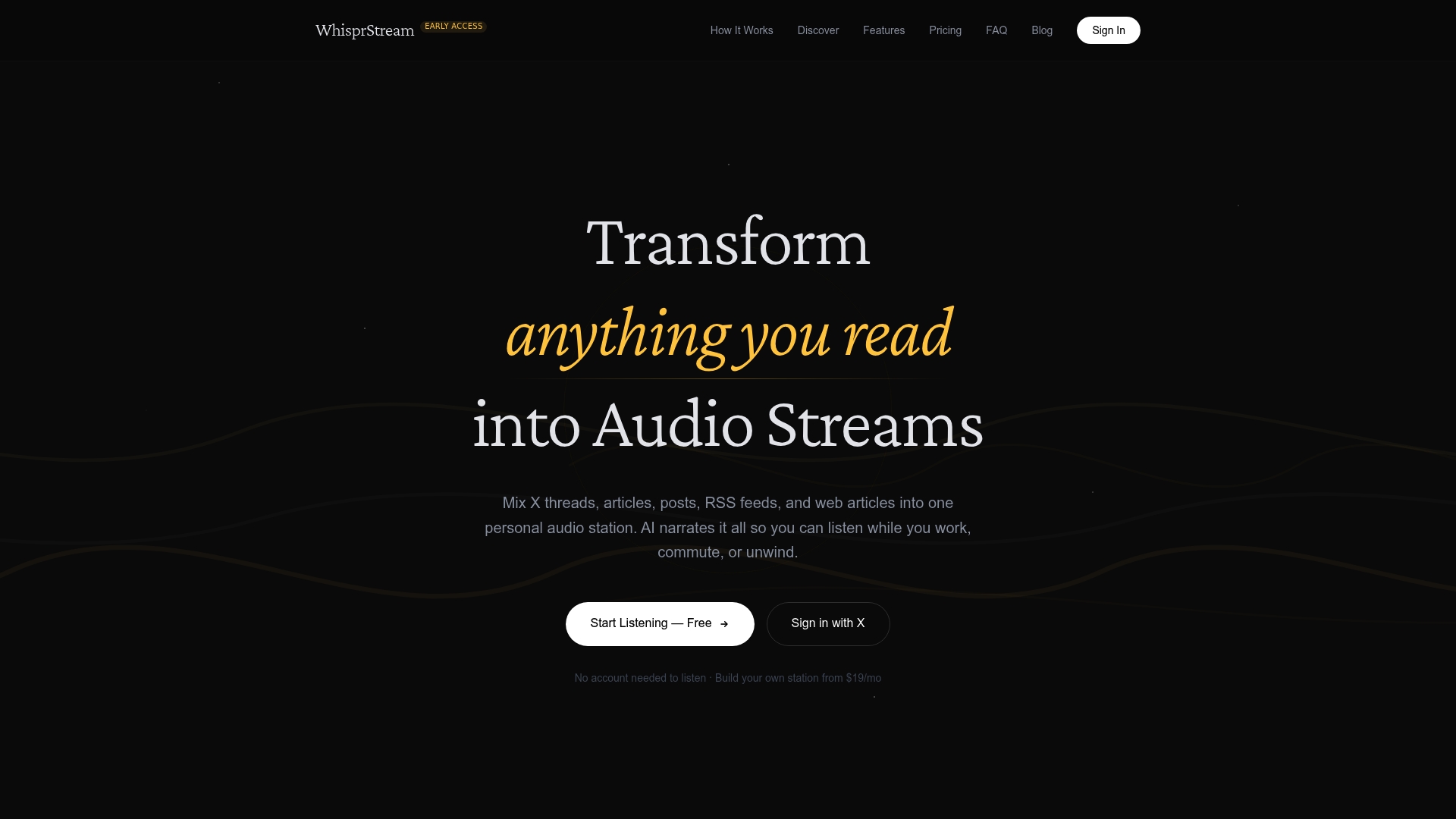
You can mix threads, articles, RSS feeds, and social posts into a single continuous audio station. The system converts those sources into narrated playback that moves between formats with smooth transitions. That continuous playback makes listening feel like a podcast feed assembled from your reading list.
Core Features
WhisprStream uses AI-powered natural narration to turn text from threads, articles, and feeds into podcast-style audio. You can create and customize personal stations by connecting social accounts or pasting RSS feeds, then save items with bookmarks and playlists. The platform also supports following community stations and streaming across devices.
Key Differentiator
The defining capability is the platform’s ability to mix multiple content types into personalized, AI-narrated stations that play on any device. That mix-and-play approach lets you assemble reading material from different sources and hear it as one continuous audio stream. The narration transitions aim to avoid awkward gaps when moving between posts and article formats.
Pros
WhisprStream supports a broad set of content formats, so you can combine social threads, longform articles, and RSS feeds into a single station that updates as sources publish. The narration reads like a podcast, which helps when you listen while walking, commuting, or doing focused work. Customization options such as voice tiers, adjustable speed, and playlists let you tailor stations for different listening contexts, and public stations can be listened to without creating an account.
Cons
- Narration fidelity may vary with complex or highly technical content, producing less accurate phrasing on some passages.
Who It’s For
This fits knowledge workers, content creators, and educators who want to convert reading material into audio for multitasking and learning. It suits people who curate daily briefings or want to follow specific threads while away from a screen. Choose this if you prefer assembling listening sessions from many sources rather than a single newsletter or podcast.
Unique Value Proposition
You can build a station by connecting social accounts or pasting RSS feeds, then follow or share public stations so others can listen without signing up. That workflow cuts the friction of turning multiple feeds into a reuseable audio briefing your team or audience can subscribe to. For small teams and individual creators, this reduces manual curation and centralizes listening across devices.
Real World Use Case
A journalist curates RSS feeds and X threads into a morning audio briefing for an editorial team. The team listens during their commute and comes to the meeting with the same context, saving time and increasing engagement.
Website: https://whisprstream.com
WellSaid
At a Glance
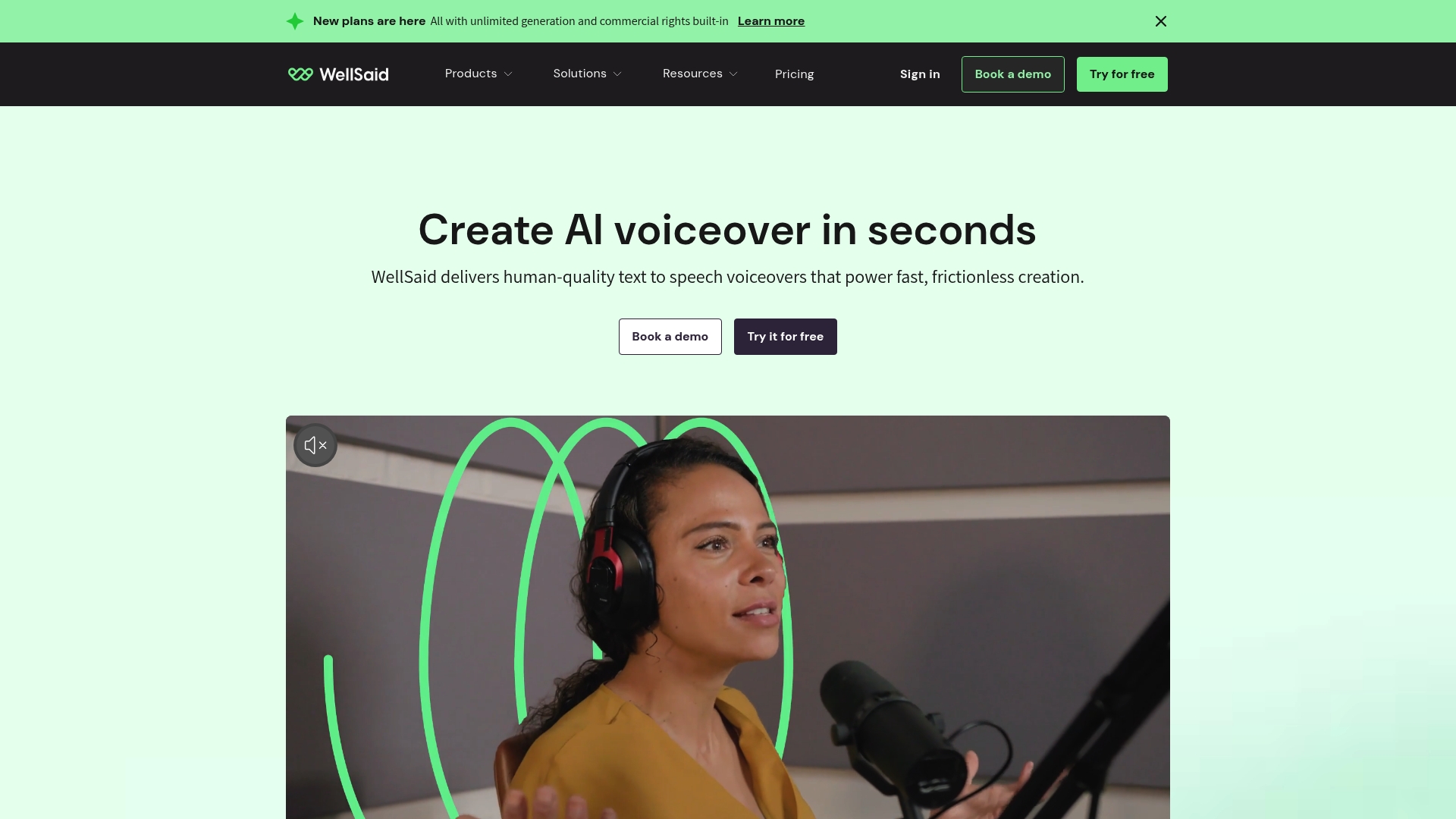
Voices are built from licensed recordings of real voice actors. The service offers Over 120 voices across accents, languages, and styles. Paid plans include unlimited generation and full commercial rights on paid tiers.
Core Features
You can adjust tone, pitch, pronunciation, pacing, and emotional expression with simple controls and pronunciation libraries. The editor supports team workflows with shared libraries, comment threads, access controls, role based permissions, and analytics. The platform connects Oxford Dictionary entries for pronunciation guidance and maintains SOC2 and GDPR compliance for secure content management.
Key Differentiator
WellSaid builds its voices from licensed actor recordings. That approach produces a human timbre and phrasing many teams prefer for brand sensitive material. The emphasis on actor derived voices targets projects where consistent narration and voice identity matter.
Pros
The voices sound highly realistic and often pass for professional human narration. The editor is approachable, so teams can create and edit voiceovers quickly, tweak pronunciation, and keep choices in shared libraries. Language coverage and the compliance measures make it practical for corporate production pipelines, and paid plans include full commercial rights.
Cons
- Subscription costs are higher than some alternatives, which may limit solo creators or very small teams.
- Occasional output can sound robotic depending on tone or style settings, requiring extra manual edits.
- Voice selection policies can feel restrictive or confusing for certain projects.
- Customer support and refund handling have received mixed reviews from customers.
When It May Not Fit
This product may not fit solo creators or very small agencies that need the lowest monthly cost. If you require flawless output without manual tuning, some voices will demand extra editing. Mixed support and refund experiences mean time sensitive projects might need a backup vendor.
Who It’s For
Teams and enterprises producing training, marketing, or video content that requires consistent voice quality will find this suitable. Production leads who need role based controls and audit style analytics will get value from the collaboration features. If you focus on quick personal projects or hobby narration, a lower cost alternative may be a better match.
Real World Use Case
A global learning team can generate multilingual onboarding videos and localize voice tracks for different regions. Editors tune pronunciation using Oxford Dictionary entries and store preferred voices in shared libraries. That reduces studio time and simplifies recurring training module production.
Pricing
Pricing starts with a free trial and individual plans from $10/month. Team plans begin at $160/month per user, and enterprise contracts offer custom pricing. Paid tiers advertise unlimited generation and full commercial rights for production use.
Website: https://wellsaid.io
ElevenLabs
At a Glance
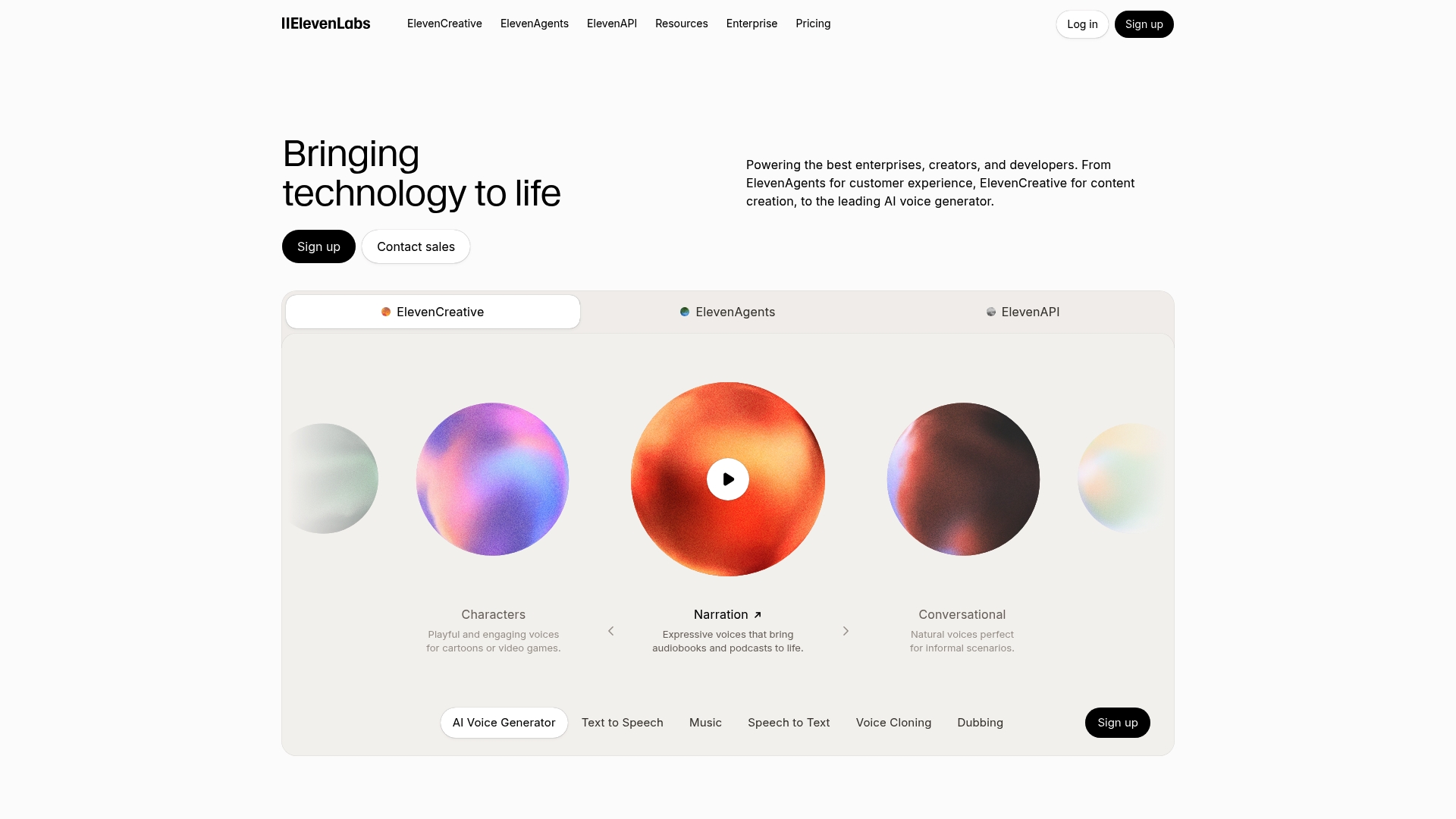
The vendor advertises expressive, lifelike speech in more than 70 languages. ElevenLabs bundles voice cloning, transcription, dubbing, music generation, sound effects, and conversational agents under a unified API. That mix positions the product for teams that need both creative audio and interactive voice services.
Core Features
ElevenLabs offers AI voice generation with expressive speech and a separate voice cloning workflow that adapts pitch and emotion. It includes speech to text transcription, dubbing and multilingual voice-over tools, plus music and sound effects generation for media projects. According to the company, enterprise security tools include SOC2, GDPR, HIPAA compliance and regional data residency options, and developer SDKs support Python and TypeScript.
Key Differentiator
The product’s proprietary speech models focus on emotional nuance and realistic cadence. That claim explains why teams pick ElevenLabs when they need characterful narration or highly specific cloned voices. The platform pairs those voice models with APIs that span creative and agent use cases.
Pros
ElevenLabs delivers notably realistic voice quality and flexible cloning, which helps creators and studios match specific character tones. Its support for expressive speech across many languages makes localization and dubbing faster. The platform offers enterprise features and developer SDKs that simplify embedding voice generation and transcription into products, and the combined creative tools cover music and sound design as well as conversational agents.
Cons
- Confusing subscription and credit management systems have frustrated some customers, especially around plan limits and credit rollovers.
- Voice handling can stumble on numbers and dates, which may require manual editing for professional outputs.
- Limited immediate human support creates delays for teams with urgent production issues.
- Reports of legacy voice models or projects being deleted without warning raise project risk concerns.
When It May Not Fit
If you need simple, predictable billing for small-scale projects, ElevenLabs’ credit model may add overhead. If precise handling of numeric data is critical, occasional voice inconsistencies could slow delivery. Organizations that require rapid, hands-on support may find the support options too slow for enterprise incident response.
Notable Integrations
ElevenLabs connects to Zapier for workflow automation and Stripe for billing workflows. Telephony and messaging integrate via Twilio, while support and CRM systems link through Zendesk and Hubspot. Cal.com is available for scheduling workflows that tie into agent deployments.
Who It’s For
Businesses and developers that need high-fidelity, customizable voice AI will get the most from ElevenLabs. Content creators producing audiobooks, podcasts, or localized video benefit from the expressive voice and dubbing tools. Enterprises that require compliance features and integration options can use the APIs to deploy voice agents at scale.
Real World Use Case
A multinational corporation uses ElevenLabs to generate multilingual customer support agents with natural-sounding voices. That approach reduces live agent load while keeping conversational tone consistent across markets. The voice cloning and dubbing features let the company reuse brand voices in several languages quickly.
Pricing
A free tier provides limited credits for testing. Paid plans start at $6/month for Starter, $22/month for Creator, $99/month for Pro, and $299/month for Scale, with custom enterprise pricing available. Billing mixes monthly plans and credit consumption, which affects long-term cost planning.
Website: https://elevenlabs.io
ReadSpeaker
At a Glance
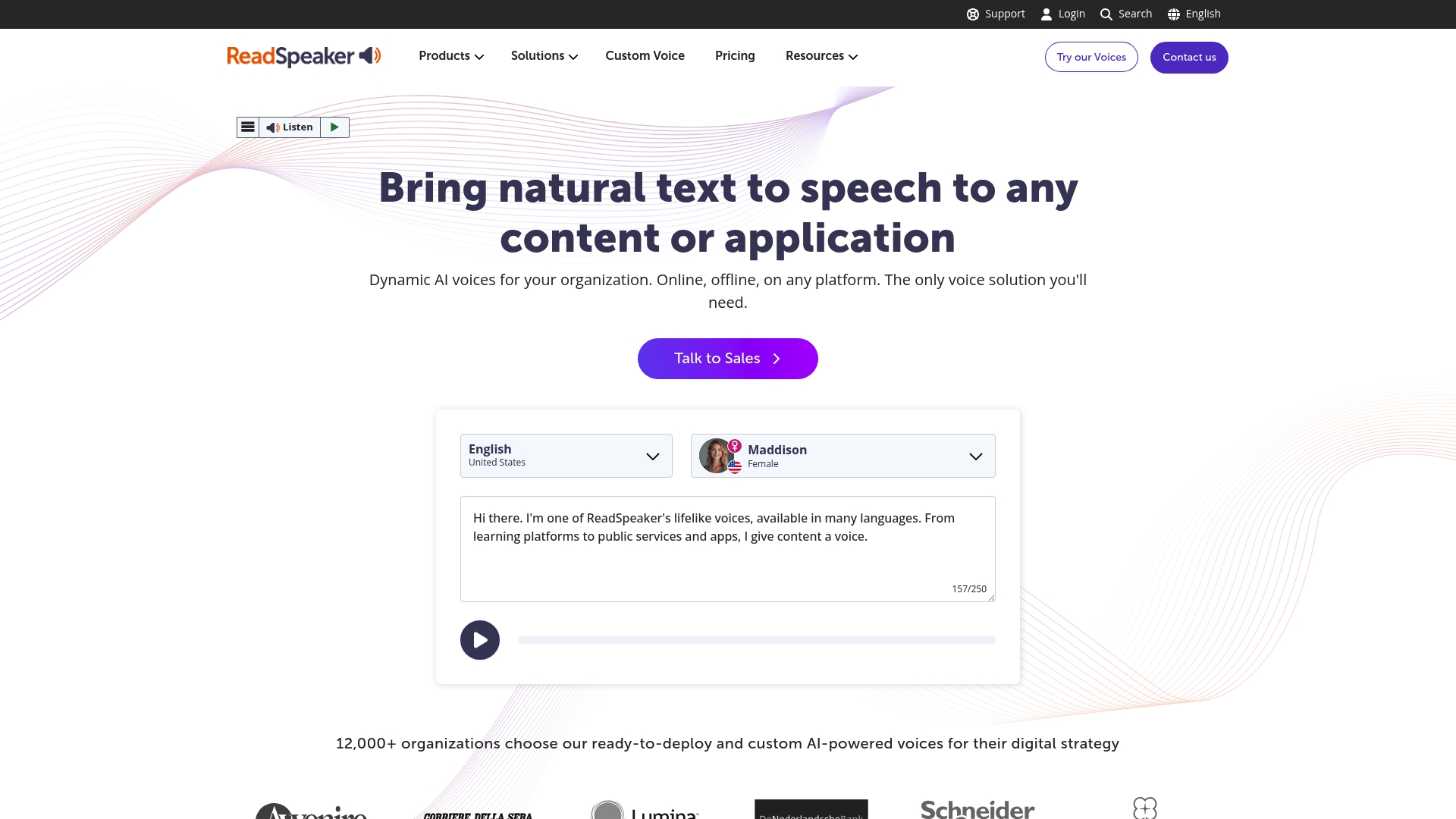
ReadSpeaker lists more than 300 voice options across 90+ languages, making it one of the more language-rich offerings for enterprise and education deployments. The product supports both cloud and on-premise hosting, which helps organizations with strict security requirements. According to the company, ReadSpeaker aligns with WCAG and ISO standards for accessibility and related compliance.
Core Features
ReadSpeaker combines browser and document readers with SDKs and APIs so developers can add audio playback into web pages, mobile apps, and learning platforms. The platform includes voice customization and pronunciation dictionaries to match branding and technical terms. Deployment choices include cloud hosting, private cloud, or on-premise installations, which lets teams pick a setup that matches their security posture.
Key Differentiator
The main differentiator is the multilingual voice library paired with deployment flexibility. Organizations can request custom voice creation or cloned voices and then host those voices on their own infrastructure if they choose. That mix of language breadth plus on-premise options suits regulated institutions that need both many languages and tight control over data.
Pros
High-quality natural voices across many languages reduce the manual work of recording multiple narrations and let teams publish audio versions quickly. Flexible deployment options, including private hosting, let IT teams keep audio processing behind corporate firewalls. Strong customization for pronunciation and voice tuning helps brands sound consistent across web content and documents, and sector-specific tools support education, government, and enterprise workflows.
Cons
-
Limited advanced feature set for power users as noted by some reviewers. This platform focuses on reliable production features rather than rapid experimental tooling.
-
Some customers report concerns about value for money. Pricing feedback varies by contract size and deployment type.
-
Mixed experiences with customer support efficiency appear in user reports. Response speed and onboarding quality may vary by region.
When It May Not Fit
Small teams or solo developers on tight budgets may find pricing and contract length a poor match. If you need experimental voice editing workflows or an ecosystem of rapid prototyping tools, the platform may feel conservative. Organizations that require a free or low-cost developer tier for proof of concept work should expect to contact sales for pricing and options.
Who It’s For
ReadSpeaker fits institutions and engineering teams that need high-quality narration across many languages and want control over hosting. Typical buyers include universities, government agencies, and large enterprises that must meet accessibility requirements and prefer vendor support for deployment. Developers who need SDKs and stable APIs for production use will find the product aligned with those needs.
Real World Use Case
A university publishes audio versions of textbooks and lecture notes by integrating ReadSpeaker into its learning management system. Instructors tag core course documents and lectures for automated narration, and disabled student services manage on-premise hosting to meet campus privacy rules. Students can stream or download narrated content for offline study.
Pricing
Pricing is not published on the public site. The offering is sold via tailored contracts that vary by deployment model, language pack, and custom voice work. Contact sales for quotes and details about on-premise licensing or enterprise support packages.
Website: https://readspeaker.com
Trinity Audio
At a Glance
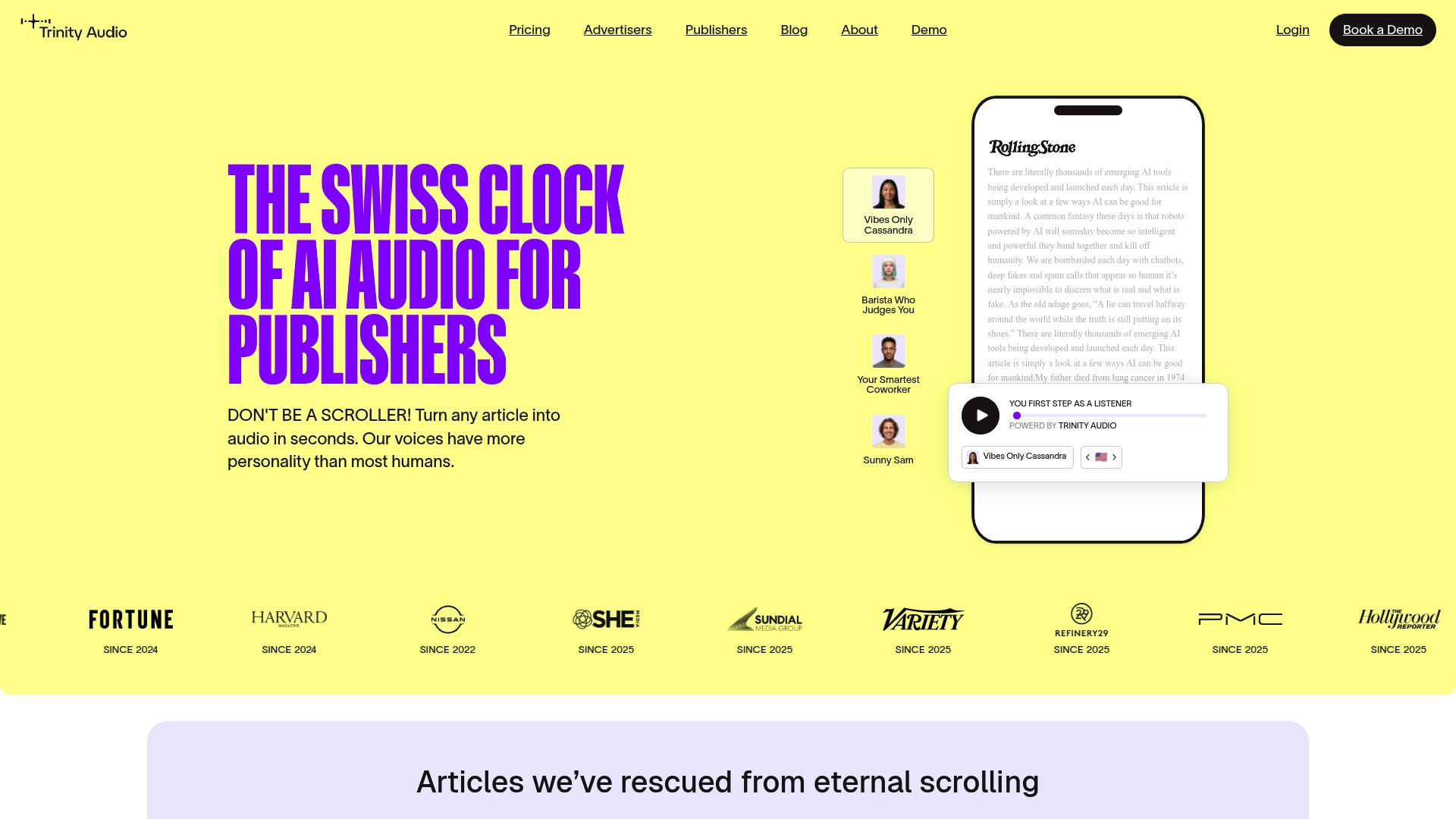
$5.42/month is the listed starting price for the Creator plan. Trinity Audio converts articles into personality-driven audio and places in-player ads to monetize listening. The offering targets publishers who want quick audio deployment with minimal technical work.
Core Features
Trinity Audio converts written content to speech using AI voices that aim to sound expressive and distinct, and it auto-embeds an audio player inside articles so readers can listen without leaving the page. The platform generates podcast-ready feeds for distribution and supports native in-player advertising to capture incremental revenue. Customizable player branding and a JavaScript snippet make deployment possible on most CMS setups.
Key Differentiator
The clearest differentiator is the emphasis on personality-driven voices paired with a low-friction deployment path. That combination targets editorial teams that want audio with character plus ad inventory without building infrastructure. The advertising integration turns listenership into direct monetization rather than a separate task.
Pros
Trinity Audio converts large volumes of written content into natural-sounding narration while preserving article structure and flow, which helps keep listeners on the page. The auto-embedding approach reduces engineering work and speeds rollout across many pages, making it practical for publishers at scale. Multiple voice and language options expand reach, and native ad support gives editorial teams a built-in way to monetize audio. Several well-known media brands use the platform, which suggests the system can handle high traffic and volume.
Cons
- Pricing transparency can be confusing. Third-party reviews point to unclear free tier limits and pricing complexity.
- Some customers report slow customer support responses and occasional setup hurdles during onboarding.
- Smaller teams with limited technical bandwidth may face installation or configuration friction despite the low-code options.
When It May Not Fit
If you need clear, self-serve pricing for exact monthly usage, this platform may feel opaque. Teams that require white-glove onboarding with guaranteed response SLAs could find support levels uneven. If you plan to build a custom audio stack with deep platform hooks, the turnkey focus may not match a highly bespoke workflow.
Notable Integrations
Trinity Audio offers a WordPress plugin, a Ghost integration, and a JavaScript snippet that works with any CMS. These three options cover standard publisher stacks and let you add audio without heavy engineering.
Who It’s For
This product fits digital publishers, newsrooms, and content platforms that want to add audio versions of articles quickly and capture ad revenue. It suits editorial teams that prefer a managed audio pipeline over building infrastructure. It also serves brands that need consistent player design and cross-article playlists.
Real World Use Case
A major news site sets Trinity Audio to convert each story into narrated audio and automatically publishes an episode into its podcast feed. The site reports increased time on page and additional ad impressions from in-player placements while offering an accessible listening option for mobile and smart-device users.
Pricing
Plans start at $5.42/month for the Creator plan and scale up for publisher and brand tiers. Enterprise and high-volume accounts require a detailed quote to capture usage, ad revenue share, and custom branding needs.
Website: https://trinityaudio.ai
SpeechGen.io
At a Glance
SpeechGen.io reports support for long form synthesis up to 2 million characters. The platform advertises advanced export options and layered background music for finished audio. It also offers an on demand credit model so you pay only for what you use.
Core Features
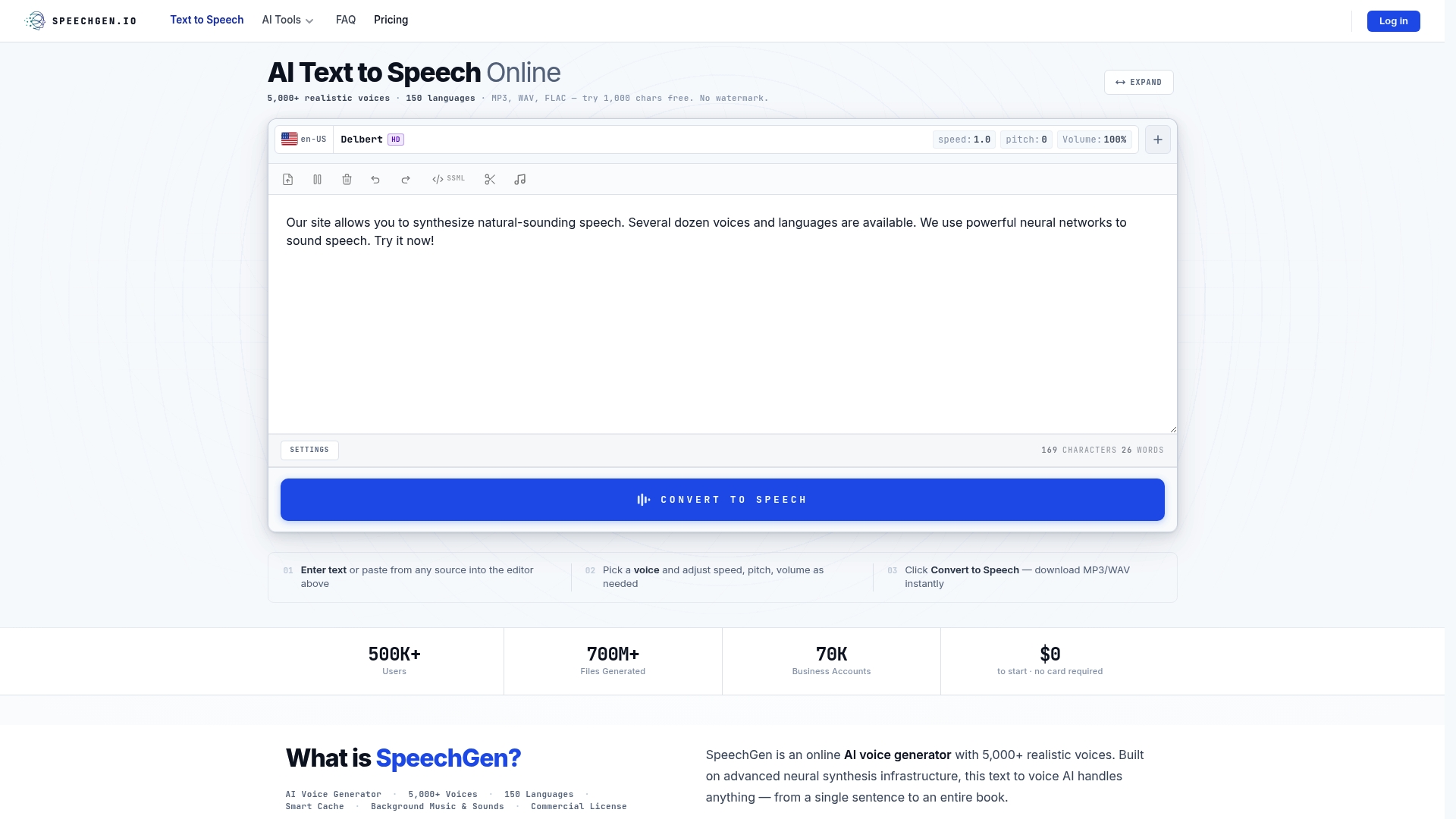
The service advertises a voice library of over 5,000 realistic voices across 150 languages and multiple voice styles. It handles very large texts and offers automatic splitting plus smart caching to reduce repeated work. Developers get a REST API, and creators can export MP3, WAV, FLAC, OGG, and OPUS with selectable bitrates and sample rates.
Key Differentiator
SpeechGen.io stands out for handling extremely long inputs with automated splitting and caching, which keeps long form projects manageable. The platform supports batch processing for books, scripts, and large transcript sets. That combination aims to cut manual file handling for high volume projects.
Pros
Highly customizable voice control covers speed, pitch, and intonation, and the product accepts SSML tags for precise timing and emphasis. The system supports multi voice and multi language projects, making localization faster and more consistent. Its credit model removes monthly fees and lets teams scale spend by buying larger credit packs with stated discounts.
Cons
-
Occasional robotic or unnatural sounding outputs require manual fine tuning to reach desired expression.
-
Advanced features like SSML and REST API require a learning curve for nontechnical users.
-
Perfect pronunciation and emotional nuance sometimes need trial and error and multiple passes.
When It May Not Fit
If you need highly emotional or theatrical narration out of the box, this product may demand more tuning than a human recorded session. Teams that lack any developer resources could find the API integration and advanced customization awkward. Buyers who prefer monthly subscriptions with predictable invoices may dislike the on demand credit model.
Who It’s For
Producers and creators who work at scale will benefit from support for long form text and batch jobs. Educators converting courses or publishers producing audiobooks can use the multi voice and automatic splitting features. Developers who want API driven automation will find the REST interface suitable for pipelines.
Real World Use Case
A marketing team localized a campaign into a dozen languages in an afternoon by assembling voice tracks for each region and using automatic splitting for video scripts. The team exported files in broadcast quality for editing and layered background music inside the platform. That workflow cut what used to be weeks of coordination into a single production day.
Pricing
The vendor lists pay as you go credits starting at $4.99 for 25,000 credits, which the company equates to about 60 minutes of audio. Credits carry one year validity and larger packs are available with discounts. The platform offers a free trial for initial testing.
Website: https://speechgen.io
Comparison of Alternatives
When selecting an AI-powered text-to-speech platform, the choice often reflects balancing content type diversity, pricing, and voice quality. Understanding the unique strengths of each platform can clarify which solution aligns best with your needs.
Where Language Coverage and Hosting Make a Difference
For organizations that prioritize multilingual audio production or require hosting flexibility, ReadSpeaker stands out. It offers one of the largest voice libraries, extending to over 90 languages, and supports cloud, private cloud, and on-premise hosting options. These capabilities make ReadSpeaker ideal for regulated sectors such as education and government, where meeting accessibility standards and strict privacy requirements are critical.
When Voice Quality and Style Are
ElevenLabs excels in generating expressive, emotion-rich voices. Its advanced voice cloning capabilities and nuanced speech generation are particularly beneficial for content creators producing audiobooks, podcasts, or branded voice identities. While its subscription and credit management systems may be complex, the platform’s specialization in creative and agent-based voice services highlights an area where it outperforms competitors.
Best Fit
- Professionals multitasking across multiple formats during active hours will benefit from WhisprStream. Its content blending across social posts, threads, articles, and RSS feeds creates uninterrupted audio streams tailored for dynamic schedules.
- Institutions disseminating multilingual and accessible audio while maintaining strict privacy controls should consider ReadSpeaker.
- Developers creating emotion-intensive projects, such as character narration or branded voice features, find ElevenLabs well-suited for executing their vision.
- Publishers seeking to monetize audio versions of written articles efficiently will gain value from Trinity Audio’s integrated ad placements.
- Scale-oriented teams working on extensive text-to-speech outputs can leverage SpeechGen.io’s large-text handling and batch processing tools.
Our Pick
WhisprStream provides convenience and customization for building continuous audio streams from diverse sources. Its capability for blending various content formats into a podcast-style playlist sets it apart. However, teams requiring multilingual narration or specific hosting arrangements might find ReadSpeaker and others in this comparison more aligned with their operational demands.
Whisprstream excels in transforming diverse text inputs into seamless audio streams for personalized listening.
| Product | Key Differentiator | Best For | Pricing | Notable Limitation |
|---|---|---|---|---|
| Whisprstream | Mixes threads, articles, and feeds into one continuous audio station | Knowledge workers and educators | Price not published | Narration may vary in complex technical contexts |
| WellSaid | Licensed actor recordings for brand-sensitive material | Teams needing commercial voiceovers | $10/month individual | Subscription costs may be limiting |
| ElevenLabs | Emotional nuance in voice and multilingual capabilities | Businesses needing high-fidelity voices | $6/month starter | Confusing subscription and credit systems |
| ReadSpeaker | Multilingual voice library and on-premise hosting | Institutions needing controlled hosting | Price not published | Limited advanced features for experimental users |
| Trinity Audio | Personality-driven voices with article-to-audio pipeline | Publishers monetizing narrated articles | $5.42/month creator | Pricing transparency can be confusing |
| SpeechGen.io | Automatic splitting and caching for long-form synthesis | Producers handling large-scale projects | $4.99/25,000 credits | Outputs may require manual emotional tuning |
How Can You Cut Through Information Overload with AI Text to Speech?
Busy professionals, content creators, and educators often struggle to find time to keep up with diverse reading sources like social media threads, articles, and RSS feeds. Whisprstream answers this challenge by turning all these text types into personalized podcast-style audio stations. You get continuous playback without awkward pauses, delivering a smooth listening experience that fits your pace.
Whisprstream makes it easy to:
- Connect your social accounts or add RSS feeds
- Mix posts, threads, and articles in one audio stream
- Customize voice speed and save playlists for repeated listening
Stop letting your reading list pile up. Visit Whisprstream to build your own AI-narrated audio station today and listen while you work, commute, or unwind.
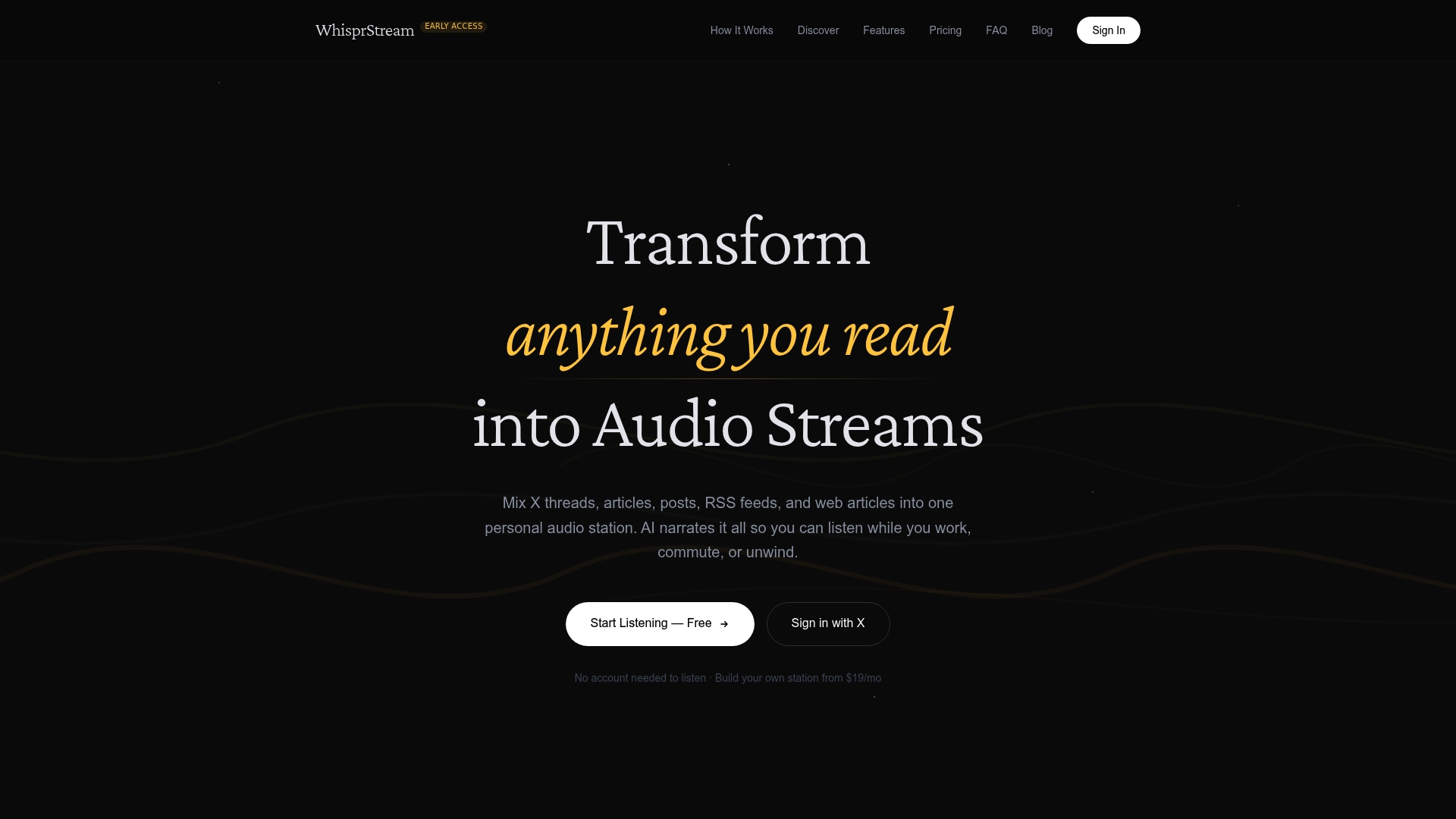
Set up your personalized audio station now and hear your content come alive with Whisprstream’s natural narration and continuous playback.
FAQ
What makes Whisprstream ideal for creating customized audio stations?
Whisprstream excels at mixing threads, articles, RSS feeds, and social posts into a single audio station. The platform’s ability to use AI-powered narration to create podcast-style audio allows users to listen to a continuous stream of content, making it perfect for multitasking during daily activities. Start building your own personalized audio station today.
How does Whisprstream compare to ElevenLabs in terms of voice quality?
ElevenLabs is noted for delivering expressive, lifelike speech in over 70 languages, appealing to developers and creators needing high-fidelity voiceovers. Whisprstream, however, provides a unique capability to mix multiple content formats into tailored audio stations that play seamlessly on any device, making it a better fit for users looking to create continuous audio experiences from diverse reading material.
Which platform supports community stations for shared listening experiences?
Whisprstream allows users to follow community stations, enabling simultaneous listening and engagement with others. This feature enhances the listening experience by fostering a sense of community around shared content, which may not be available in other alternatives. Consider constructing your own public station to share with others.
Can I use Whisprstream for technical or highly complex content?
While Whisprstream provides smooth transitions and continuous playback, it may struggle with complex or technical content in terms of narration fidelity. Users seeking the best results with intricate material should be aware of this limitation when using Whisprstream for diverse content types.
What pricing tiers does Whisprstream offer for users?
Whisprstream features a pricing structure that supports a broad set of content formats, allowing users to examine cost-effective options adapted to their needs. By creating a personalized audio experience that combines various sources, users can choose tiers that match their listening consumption styles without needing extensive commitments.